


By: Sylene Argent, Local Journalism Initiative Reporter, Essex Free Press
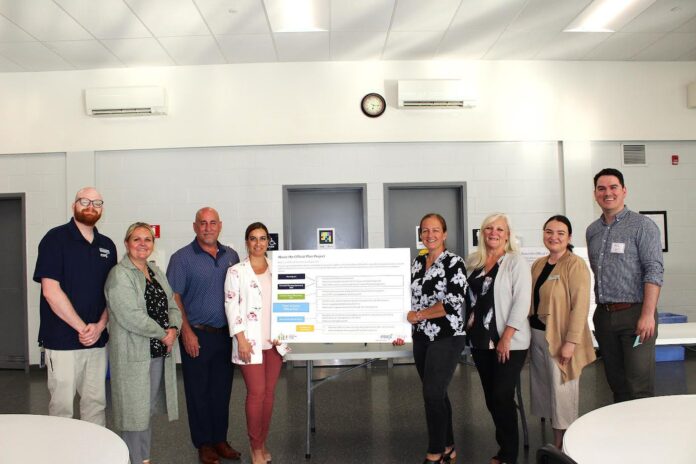
The results of work completed on the Colchester Secondary Plan and Local Settlement Area Review (LSAR) as part of the Town’s Official Plan (OP) process were presented to residents and stakeholders during an open house hosted at the Essex Centre Sports Complex on Thursday, June 18.
So was the New 2026 draft OP, ensuring it conforms with the Provincial Planning Statement (PPS) and the County of Essex’s new Official Plan, which was adopted and approved by the province last year. Changes to the Town of Essex’s document were made to encourage residential intensification in primary settlement areas, where municipal and community services exist and where the Town wants to direct growth in those areas.
Essex’s new OP document – an overarching document that sets out land-use and development policies for the next 25- years – is being developed to set the tone on how to use the land in the Town of Essex over the next 25-years. Through the document, policies are set for growth and development.
The Colchester Secondary Plan is a component of the Town of Essex’s OP.
The LSAR focused on two categories of land: employment and residential.
The OP was created in 2009, and updated in 2015. Council initiated a New OP in 2022. They have to be reviewed every five-years. However, in the fall of 2024, a majority Essex Council voted to tap the brakes on adopting the draft Official Plan (OP), giving Town Administration direction to complete a second phase of the project before its adoption.
That included completing the LSAR, meant to determine the opportunities and constraints associated with Town of Essex land use designations, particularly Primary and Secondary Settlement Areas, and the appropriateness of the current settlement areas to accommodate the forthcoming growth.
The OP documents have undergone substantial changes in the past year-and-a-half to two-years, Lori Charwick, Director of Planning Services, said.
“We have heard a lot of great feedback from the residents, particularly [with] the Colchester Secondary Plan,” Chadwick said, noting policies were revised to have a better balance of tourism and existing residents. “We wanted to be able to support an appropriate mix of uses – highlighting tourism – but without clouding and overshadowing the needs of the existing residents.”
Residents voiced concern the previous Colchester Secondary Plan had too much emphasis on tourism, so Town staff ensured there was more balance between resident and community needs and tourism.
What was once proposed as Waterfront Commercial is now being proposed to be Neighbourhood and Parks and Open Space along Sullivan. A character-defining area is proposed to preserve heritage structures. Policies in the north-west greenfield quadrant are proposed to align with the rest of the neighbouring designation (the Colchester Bay development) rather than a standalone separate policy. The proposal is still in draft, and the developer continues to be patient as this project is completed, Chadwick explained.
Town staff have also looked at land-use designations, as titles have changed slightly. What used to be called “urban residential” is now proposed to be “neighbourhood,” “industrial” is proposed to be “employment,” and “commercial” is proposed to be called “corridor.”
Following the decision to tap the brakes on the OP to conduct the additional activities, in September of 2025, the Town of Essex began the process of creating a ten-person focus group – with a range of opinions – to help refine the Colchester Secondary Plan, which sets out a cohesive vision and a set of planning directions for the future growth and development.
Chadwick said it was such a great experience to workshop with the Focus Group, which was comprised of property owners, engaged citizens, business owners, and new and long-standing residents. There was a lot more interest in joining the group than in one previously put together a few years prior.
“The members were very engaged. Not only did they attend a workshop to work through some of the proposed changes, but they provided us with valuable feedback,” Chadwick said. They had homework – for example – that they took very seriously and provided us with input into a lot of questions.”
She added members also helped to develop a new vision statement for the Colchester Secondary Plan, helped revise many policies, and were an integral part of shaping the document.
“They were amazing.”
The County’s OP noted Essex requires an expansion to its Settlement Area for more jobs for the next 25-years.
In terms of residential lands, the County OP determined Essex does not need to expand its settlement area to accommodate growth productions. So, Essex’s staff took a holistic review of both primary settlement areas (Essex Centre and Harrow) and the three secondary settlement areas (Colchester, Lakeshore West, and McGregor), and performed an exercise to look at growth capacity, land supply, potential for residential intensification, and municipal services and other limitations.
While Essex still has some collaboration to do with the County, Essex is looking at where growth is wanted to be directed.
There is an opportunity in McGregor, for example, but there are servicing constraints in terms of sewage. That is overseen by the Town of Amherstburg. Essex staff said it is premature to remove any designations until both Councils decide on how to proceed.
Chadwick said staff is creating a land bank, which identifies and quantifies future lands to reallocate to a primary settlement area, if Council directs that and if infrastructure and community services are wanted to be directed for growth.
The County has determined Essex needs 45.8 hectares of employment industrial lands by 2051, which the Town could designate now or put it in a land bank for future designation.
The lands in Lakeshore West, residents and Council reps have noted, have constraints. Staff recommendation is to overlay a special policy area to require any developers to complete a flood inundation study before any development occurs. The other concept would be if there are lands that are fully constrained that the Town would not support any development and that they could be put into a land bank to be reallocated to a primary settlement area.
Colchester resident John Roung believes many issues still remain for existing residents in his area.
After viewing the special Council meeting on June 1 on the Colchester Secondary Plan, he felt somewhat encouraged by the concerns and comments expressed by several Councillors.
“While the Planning Consultant has an academic focus and provided great theoretical detail, it fails to recognize many of the expressed concerns of the actual residents, which are subjective in nature – not quantifiable – overall being our lifestyle preference,” he wrote the Essex Free Press.
Topics he believes require attention include flooding, especially in the Lakeshore area west of the village south of County Road 50), proximity to schools and work areas, busing needs, traffic activity in Colchester, policing requirements, noise levels, infrastructure needs, aesthetic appeal, population density (especially within areas available for subdivision, condos, or apartment buildings), future burden on residents in tax load.
While mentioning maintaining the “character” of Colchester in policies, Roung believes the draft leaves the door open to irreversible and undesired developments that could impact the true “character” of Colchester. He strongly supported the prioritizing and efforts needed to further developments in Harrow, McGregor, and Essex Centre.
A second public open house is scheduled to take part in the southern-end of the municipality at the Harrow Arena on Tuesday, June 23, from 6pm to 8pm, at the Harrow & Colchester South Community Centre.
In addition, the Essex 2026 draft OP is available at www.essex.ca/officialplan, until the end of August. Residents can provide input in that timeframe. In the meantime, Planning staff are looking to continue connecting with residents, agencies, First Nations, and Council to get to a final draft. It is hoped to present that final draft this coming fall for consideration, with the hope of doing so before the Municipal Election. Residents can connect directly with planning staff by emailing officialplan@essex.ca.