


By: Kenneth Pastushyn, Local Journalism Initiative Reporter, Tilbury Times Reporter
In late March, the City of Windsor agreed “in principle” to commit Ojibway Park to a proposed national urban park.
What that means is Parks Canada can now go ahead and bring the provincially owned Ojibway Prairie Nature Reserve across the street along with the addition of Ojibway Shores to form the Ojibway National Urban Park system.
Windsor would still own the park, Ontario would still own the prairie, but Parks Canada would manage the combined areas.
There is also a proposal for an eventual expansion into the LaSalle Woods, Brunet Park and Stanton Woods. The Reaume Prairie may also be added.
The Friends of Ojibway Prairie community advocacy group have been involved in the consultation process for five years and consider the announcement as a sign of good news.
The problem is all the details haven’t been sorted out and there is no timeline for deadlines.
However, city officials remain optimistic that it will be finalized by the end of the year.
In the meantime, we wait. And while waiting, we may as well enjoy Ojibway Park and the Prairie Complex.
The Tilbury Times Reporter reached out to the Friends of Ojibway Prairie requesting a guided tour of the park and prairie one Sunday morning in April.
The guided tour began in front of the demonstration garden next to the nature centre, where volunteers gather and plant seeds found throughout the park and prairie in the spring and work meticulously through the fall by cultivating them.
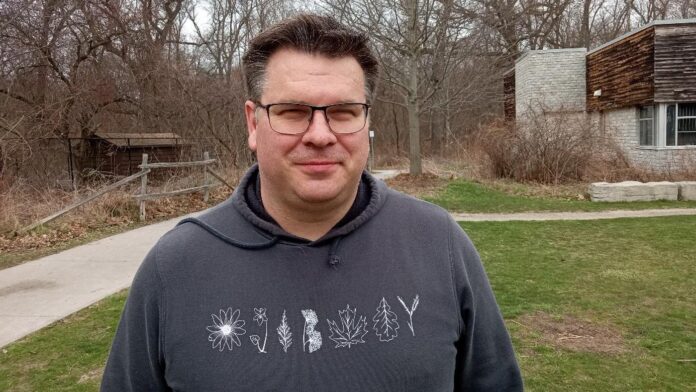
“One of the one’s particularly known for us at Ojibway is dense blazing star and large leaf aster,” said Mike Fisher, president of the Friends of Ojibway Prairie. He also said wild bergamot, black-eyed Susans and gray headed coneflowers are “really beautiful to see.”
People tend to think about Ojibway Park as a hotspot for birdwatchers. Also next to the demonstration garden is the bird shed which was our next stop. Fisher pointed to the wooden fence on the viewing porch filled with photos of common birds found in the trees of Ojibway: blackbirds, blue jays, buntings, cardinals, catbirds, chickadees, cowbirds, doves, finches, grackles, hummingbirds, nuthatches, orioles, robins, siskens, sparrows, towhees, woodpeckers and wrens.
Fisher brought up the annual butterfly count to find as many species as possible at Ojibway in July. When asked about his favorite butterfly, Fisher mentioned the viceroy which people often confuse with the monarch. He also said the viceroy is on the latest
ACT NOW PROTECT OJIBWAY NATIONAL URBAN PARK FOREVER signs to plant on front lawns.
“We are giving away a lot of signs in the LaSalle area,” said Fisher. “People want to see it protected.”
People as in conservationists, also want to see the Blandings turtle protected which has a “threatened species” status in Ontario and on the “Protect Ojibway” sign as well.
We then headed to the Pond Boardwalk, a popular spot for families to come and watch waterfowl like the heron, who is here to hunt for fish, to amphibians like the painted turtle.
“You can come here to see the turtles sunning themselves on top of logs in July depending on the water levels,” said Fisher. “If the water level is high enough and the weather is warm enough, you’ll definitely see them sunning themselves.”
A good sign that spring is here, according to Fisher, is when you see and hear the arrival of red-winged blackbirds around the pond, which were plentiful during our morning stroll.
“It’s so good for your physical health, your mental health and your social health, getting out and seeing nature,” said Fisher as we continued our walk through the Carolinian forest.
The trails that are joined together, whether filled with wood chips, gravel or paved, which is meant to be the most accessible for people of all ages and mobility issues.
Fisher loves early morning walks in the woods when the oak trees are filled with green leaves and rustle of the wind.
“For a few moments, you feel like you’re in the wilderness and away from the hustle and bustle of the city,” said Fisher.
Another reason why Fisher loves Ojibway is because of its biodiversity which is nationally recognized. Over 160 rare species at Ojibway according to Fisher.“Pound for pound, Ojibway is one of the best examples of biodiversity in the country,” declared Fisher.
One example is the tufted titmouse, which Fisher is a huge fan of. It’s the official bird of Windsor and the unofficial bird of Ojibway Park. He says, “they are particularly unique to this area” and you can see them here year-round. (If so, then the tufted titmouse should be on the “Protect Ojibway” sign instead of the yellow-throated warbler.)
“It’s truly special nationally and that’s why Parks Canada is investing so strongly here,” said Fisher.
To be exact, the federal government has assigned $36.1 million to establish the national urban park and an annual operating budget of $4.6 million.
“Canadians associate themselves with nature and natural parks more strongly than hockey or the Maple Leaf as the Canadian symbol,” declared Fisher as we crossed the street heading towards the prairie complex early in the afternoon.
Officially known as Tallgrass Prairie Heritage Park and is perfect for hiking. There is a lesser density of trees than in the park, but you still can see a lot of bird houses meant to attract Eastern blue birds.
Plenty of cleared paths along the tallgrass prairie and is a little quieter than the park in terms of activity.
There is an extremely slim chance of encountering the Eastern massasauga rattle snake (which is also on the “Protect Ojibway” sign) due to its “threatened status.” Efforts to repatriate the species have been made by conservation groups like Wildlife Preservation Canada.
Should you come in contact wit a massasauga rattler, Fisher recommends keeping your distance, remain calm because they are not aggressive and warn the nature centre.
It should not be a deterrent to keep you from coming to and enjoying the Ojibway Prairie Complex.
Hopefully by the end of the year, there will be an Ojibway Urban National Park with permanent protection under the highest levels of federal law. That is the City of Windsor’s estimate.