
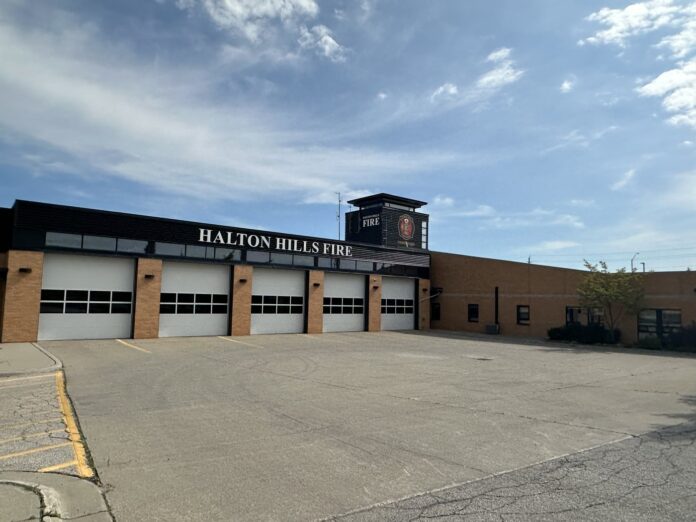


By: Christian Collington, Local Journalism Initiative Reporter, TheIFP.ca
Now in the second year of the five-year Fire Master Plan, Halton Hills Fire Chief Martin Mills is ensuring staffing, infrastructure and public education keep pace with town growth and surging call volumes.
Call volumes are projected to climb from under 1,000 to 1,300 this year alone — a reality that grounds the flexible roadmap developed alongside the Halton Hills Professional Fire Fighters Association, mayor and council.
“This is a comprehensive evaluation of basically what we’ve done in the past, what we’re doing right now and what we’re looking to do in the future,” he said.
Building front-line ranks for a growing town
When the master plan was first developed in 2024, Mills said Halton Hills operated with “about 42 full-time firefighters.”
In the past two years, that complement has grown to 56, with a target of 60 full-time members supported by roughly “64 part-time firefighters,” he said.
Response times drive these targets. Mills said full-time crews aim to be out the door within 90 seconds and on scene within four to five minutes; part-time firefighters, who travel from home or work when paged, typically arrive five to six minutes later.
Planning for infrastructure and a fourth station
One major long-term recommendation in the plan is the addition of a fourth fire station, likely in the south Georgetown and Steeles Avenue area — a corridor Mills described as “really, really growing.”
“If there was a fourth station, that’s probably the area that it would go in,” he said.
The recommendation comes as Halton Hills’ population is projected to grow to 132,000 by 2051, accompanied by employment growth in the Premier Gateway area.
However, opening a new facility requires significant investment. Mills said staffing that station with four firefighters per shift on four platoons means hiring “about 20 new firefighters” once vacation and sick coverage are factored in.
Combined with land and construction costs, Mills expects this major investment to be “roughly 10 years” away. Until then, Halton Hills relies on mutual aid partnerships with Milton and Mississauga to cover gaps like the Highway 401 corridor.
“You just can’t do everything,” Mills said. “You need your partners.”
Prevention, public education and budget realities
The plan places growing emphasis on public education and fire prevention.
Mills said the Halton Hills Fire Department is involved in “two to three public events every week,” along with school visits and community outreach.
“If we can get those messages out, then hopefully suppression’s not needed as much,” Mills said.
To support that work, the town has approved hiring a full-time fire prevention officer and another officer whose role will be split with public education starting next year.
Budget constraints shape how quickly all of this can happen.
Alexandra Fuller, the town’s director of communications, said that every request must recognize the broader financial picture.
“We recognize there’s only one taxpayer,” Fuller said. “Life safety is always at the top of the list.”
Mills said a dedicated levy is helping to fund future hires, including platoon chiefs planned for “around 2028, 2029.”
Whether the fire service can keep up with the growth of the town, Mills noted that call volume is projected to climb from under 1,000 calls to 1,300 calls this year but the department is investing heavily in data collection on call types and response times to justify future recommendations.
As Halton Hills continues to grow, Mills said the department’s challenge is to match that pace without losing sight of its core mission.
“This isn’t just about adding firefighters or building stations,” he said. “It’s about making sure that as our town changes, people know we’ll be there when they need us and we’re doing everything we can to keep them safe.”