HomeNewsLaSalle-based Ecology Centre uses Lake Sturgeon to inspire learning across generations

LaSalle-based Ecology Centre uses Lake Sturgeon to inspire learning across generations

Published on

spot_img

By Kenneth Pastushyn

With the guidance of Professor Dr. Trevor Pitcher, a Walpole Island First Nations immersion school will raise juvenile Lake Sturgeon as part of their curriculum in a new fish hatchery.

The opening ceremony occurred in mid-April, providing children the chance to learn about marine biology and the importance of safeguarding local waterways.

“Students will start the school year with eggs provided and at the end of the year release young fish
into the wild,” said Pitcher, director of the University of Windsor’s Freshwater Restoration
Ecology Centre (FREC), which is located along the Detroit River in LaSalle.

For nearly a decade, children from Walpole Island have been visiting FREC on field trips and
have begun asking whether their school could have its own hatchery. Pitcher and school
coordinators helped make that vision a reality.

The goal is to work to restore threatened fish populations and nurture a new generation of
“Great Lakes caretakers.”

At FREC, a part of the university’s Great Lakes Institute for Ecological Restoration (GLIER) and First Nations immersion school, guests at the lab can walk up onto a platform and observe indoor tanks similar to an aquarium.

During visits to FREC, Pitcher frequently engages with school groups, senior citizens, and community organizations, often using visual aids such as a nearly six-inch, 3-D printed juvenile sturgeon. He also shares photos of himself and his graduate students from GLIER posing with their notable sturgeon catches before releasing them back into the water.

One photo depicts Dr. Pitcher with two students holding up two 30-year-old sturgeons, which are considered teenagers due to their slow growth.

“It takes a sturgeon 20 years to mature and can live up to a hundred,” said Pitcher.

Another photo shows Pitcher and another graduate student holding up a 150-pound sturgeon
approximately 80 years old and six feet long.

“These sturgeons are so old that they were swimming around when your grandparents were born,”
said Pitcher. “This six-foot animal can live up to a hundred years and is the closest thing we have to
dinosaurs.”

Prehistoric “living fossils,” is how Pitcher describes the lake Sturgeon and imagines them as “lonely
torpedoes cruising through the Great Lakes,” where they spawn. They are often being poached
for the eggs inside their bellies to make caviar.

There are also egg samples inside test tubes, another visual aid shown to visitors at the FREC lab.

“The Lake Sturgeon once thrived throughout the Great Lakes but declined dramatically due to
overfishing, habitat loss and pollution,” said Pitcher.
Now, vast quantities of juvenile lake sturgeon are being reintroduced back into their natural
habitat thanks to the research of GLIER and FREC, which is the only facility of its kind on the
Canadian side of the Great Lakes Basin.

At FREC, research is conducted on water quality, endangered species, and habitat restoration. The laboratory contains various tanks, from minimally furnished ones to highly enriched environments filled with numerous rocks to simulate natural habitats.

Then, Pitcher and his team track their behaviors, stress levels, and swimming capabilities to assess their survival prospects post-release. Fisher mentioned, “Often, all the fish are tagged so their progress can be monitored over decades.”
The Lake Sturgeon is currently a species “at risk.”

“When you talk about species at risk, it’s important to recognize these are multi-generational
problems,” said Pitcher. “This isn’t something that will be solved in the next five or 10 years. It’s
the next 25 to 30 years.”

Other species at risk being studied at FREC include Pacific Chinook salmon, while Atlantic salmon and redside dace are classified as endangered. Trout in Lake Huron have a sustainable rating due to restocking efforts and invasive species management.

Lake sturgeons have been known to eat invasive species such as sea lampreys, goby fish and
zebra mussels.

“These important fish have been around for so long, we don’t know what the ecosystem would
look like without them,” said Pitcher, referring to the lake sturgeon.

Throughout the academic year, FREC often hosts tours and workshops for the Greater Essex
County District School Board. These tours range from third graders learning about invasive species and
spawning habits to ninth grade students learning about biodiversity and environmental restoration.

Pitcher believes the lessons taught through initiatives like this carry a powerful message: “Lake
sturgeon can live for more than a century, meaning fish being released into Great Lakes waters
today may still be swimming for generations to come.”

CUTLINE:

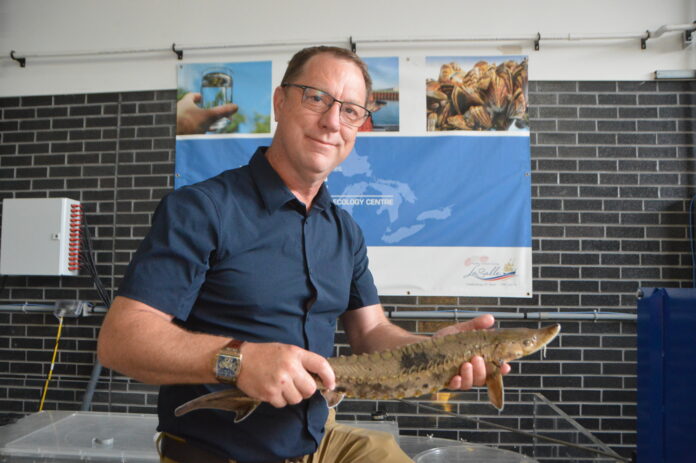
Dr. Trevor Pitcher, director of the University of Windsor’s Freshwater Restoration Ecology Centre in LaSalle, holds a two-year-old lake sturgeon weighing eight pounds and being reared as part of the conservation efforts occurring around the Great Lakes.

Latest articles

Council Connect: Highlights from August 19, 2026, meetings of Council

Emergency Management Plan, August 2026: Council received a report summarizing several changes and improvements...

Town of LaSalle Announces Retirement of CAO Joe Milicia

Staff Reporter The Town of LaSalle announces the retirement of Chief Administrative Officer (CAO) Joe...

Secure Your Spot at LaSalle’s End-of-Summer Celebration, Last Call Before Fall

By Matt Weingarden As the summer winds down, join in the Last Call Before Fall...

HiGGi Country Music Heats Up LaSalle’s Last Call Before Fall

By Matt Weingarden This September, LaSalle’s fourth annual Last Call Before Fall (LCBF) returns with...

More like this

Council Connect: Highlights from August 19, 2026, meetings of Council

Emergency Management Plan, August 2026: Council received a report summarizing several changes and improvements...

Town of LaSalle Announces Retirement of CAO Joe Milicia

Staff Reporter The Town of LaSalle announces the retirement of Chief Administrative Officer (CAO) Joe...

Secure Your Spot at LaSalle’s End-of-Summer Celebration, Last Call Before Fall

By Matt Weingarden As the summer winds down, join in the Last Call Before Fall...