


By: Michael Bennett, Local Journalism Initiative Reporter,The Ridgetown Independent News
After spending close to 25 years providing senior leadership in the public healthcare sector across the province, Cory Gosnell took time off at his Orford Twp. home to ponder this future.
Instead of having to move again or commuting to his next job, he will be able to stay in his Hilltop Farm home and make the short drive to Chatham.
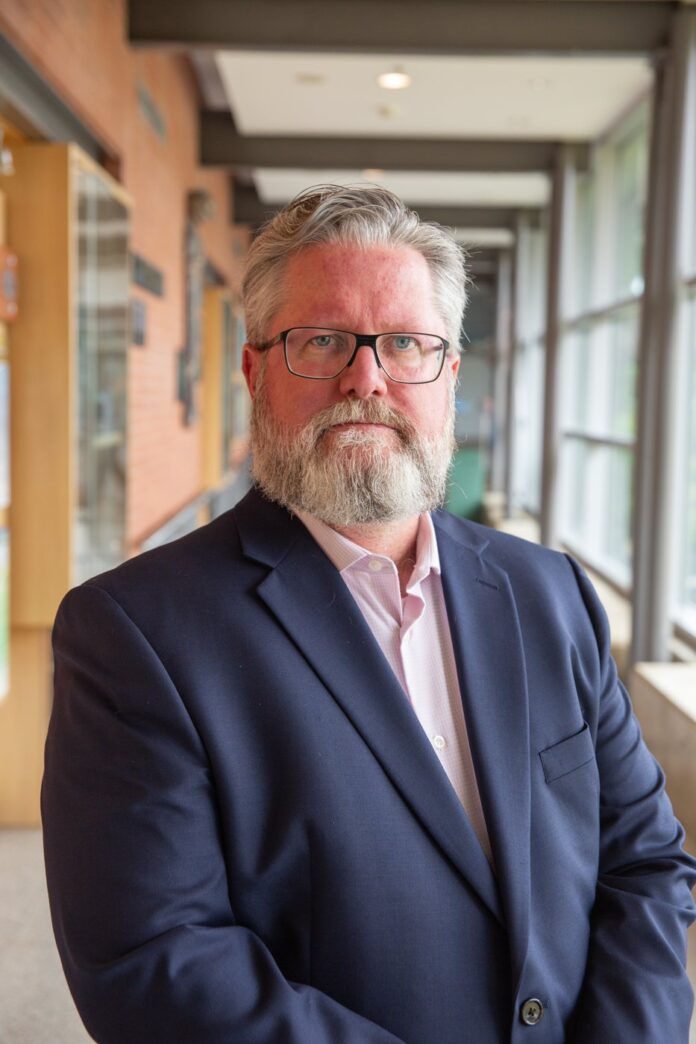
Gosnell was recently named the new Executive Transformation Lead of the Chatham-Kent Ontario Health Team.
He replaces Melissa Harrigan, a Chatham-Kent Councillor, who was named the new Chief Executive Officer of the Canadian Mental Health Association Lambton Kent Branch in April.
“I look forward to stepping into my new role, listening to the needs of the residents of the region and working alongside the incredible healthcare professionals and organizations throughout Chatham-Kent to deliver the best outcomes we can for our community,” Gosnell said.
The CKOHT, one of the first 24 Ontario Health Teams when it was founded in 2019, is comprised of 54 different organizations with a primary objective of bringing together partners across all sectors – including hospital, home and community care, primary care, long-term care, social and community support services – to deliver seamless, fully coordinated care to residents of Chatham-Kent.
“My role is basically bringing them (organizations) together to help identify the barriers and challenges for both patients and providers within Chatham-Kent, and how do we collectively want to invest time, resources, and money trying to break down those barriers,” Gosnell said.
The CKOHT recently completed a new five-year strategic plan, taking the organization through 2030.
Gosnell will bring a fresh set of eyes to help the CKOHT achieve its goals through its three pillars – Strengthen the Comprehensive Primary Care System; Cultivating a High-Performing, Accountable Health Team; and Embedding Health Equity and Inclusion.
“They have some ideas for early in the plan, and some of the projects are already in play, but it’s really going to be me working with these partner organizations to help define what those early year objectives and initiatives are going to look like and how do you plan on securing funding to put them in to practice,” Gosnell said. “My main focus is how put the legs underneath those plans so at the end of five years, we can look back and say that we have more people attached to primary care, we’ve improved access to primary care, we’ve eliminated inefficiencies in the system that cause delay in terms of access to care – those things that really are cross sectoral that we’ve been able to make movement.”
Gosnell said there are tremendous challenges within the public sector, including financial pressures that all organizations face, as well as health and resource constraints.
“We have an aging population of providers who are looking to retire, so what’s the pipeline of getting people in who can fill those gaps?” Gosnell said. “We’re going to be losing a lot of experienced knowledge, and a new grad is not the same as someone who has been working in the field for 35 to 40 years.”
Gosnell said Chatham-Kent’s expansive rural geography is another challenge.
“Chatham-Kent is unique in the sense that it really is quite rural, we have one large hospital provider, and there’s a huge dependency on primary care,” he said. “What does that look like in terms of how we approach things like improving access to care, caring for an aging population?”
“It’s going to be different in Chatham-Kent than it is going to be in London or Toronto,” he said.
One area of expertise Gosnell brings to the CKOHT is his provincial-level experience with Cancer Care Ontario, as he will represent the local chapter at the Ontario Health Team table.
“When I was with Cancer Care Ontario, you get to participate in terms of a provincial level to help influence and inform policy,” he stated. “Now I can bring the voice of Chatham-Kent and the uniqueness of our OHT to the table to help influence the direction the Ministry is going to be taking.”
Gosnell, 49, grew up on the family farm in Orford Twp., attended Orford Public School and Ridgetown District High School, and then attended Trent University from 1996-99, earning a Bachelor of Arts in Political Science and Economics.
He served as Project Manager of the Foresters in the Greater Toronto Area and Project Manager at Magna International before his first role in health care.
Gosnell had a 15-month tenure as Manager of the Data Management Unit in the Ministry of Health and Long-Term Care in Toronto, followed by 16 months as Manager of the Continuing Care eHealth Council.
Gosnell held the position of Manager, Informatics, at Cancer Care Ontario from March 2006 to November 2010, where he developed relationships with business partners to align informatics-related activities across the organization better.
Gosnell then spent three and a half years as the Clinical Administrative Director of Cancer Services at Kingston General Hospital.
He spent the next seven years at London Health Sciences Centre, where he held positions as Director of Health Information Management & Decision Support, Interim Director of Health Information Management & Decision Analytics, and Program Director of Cancer Services at the London Regional Cancer Program.
Gosnell was named Chief Operating Officer of the Lawson Health Research Institute in July 2022, a position he held until April 2025.
While working at Lawson, Gosnell and his partner, Richard Wilson, wanted to get out of the city, so they moved back to Orford Twp., where they built a home on his family farm, allowing him to commute to London.Gosnell became involved in the community, serving on the Highgate District Agricultural Society.
After leaving Lawson, Gosnell worked as an independent contractor and consultant while pondering his future.
“I took time off for myself to recharge my batteries,” Gosnell said. “It was nice to have that break, where I was able to reflect on what has really given me a lot of joy and personal satisfaction over the years.”
Gosnell said it was interesting that he studied political science and economics at university, but spent the majority of his career in life care.
“I’m curious by nature. When you engage with others, you draw on the knowledge around you, and that’s where I’ve been successful in bringing groups together and leveraging collective knowledge,” he stated.
Gosnell said he was able to carry over skills learned from his time working for the government and provincial agencies into his leadership roles in health care.
“Leadership in the cancer clinical program gave me insight into hospital operations, and that allowed me to move into the support services area, and the opportunity to move into research came out of that,” Gosnell said. “It’s been accumulative in terms of building and adding to what I call my tool kit,” he said, with a laugh, about his extensive portfolio.”
During his hiatus, he began to consider his next career step.
“I was looking at opportunities and was hoping to find something that would keep me close to home,” he said. “So when this (CKOHT) came up, I thought the timing was good, and the role looked really, really interesting.”
Gosnell started his new position on Monday.
“This is a nice culmination of living back home and being in a role to bring the skill set and knowledge to the area to hopefully make a meaningful difference for the residents of Chatham-Kent,” Gosnell ended.