


By: Sylene Argent, Local Journalism Initiative Reporter, Essex Free Press
When the County of Essex and Essex-Windsor EMS organized the first collaborative symposium on legacy oil and gas well emergency response in London back in early March, it caught the attention of Ontario Minister of Natural Resources, Mike Harris JR.
With the ongoing concern and work put into the abandoned oil and gas wells across nine Ontario communities – of which Essex County is one – Minister Harris announced the Ministry of Natural Resources (MNR) would add an additional $7.8M to existing funding earmarked to protect communities from potential risks they pose. That increased this year’s total investment to $10.8M.
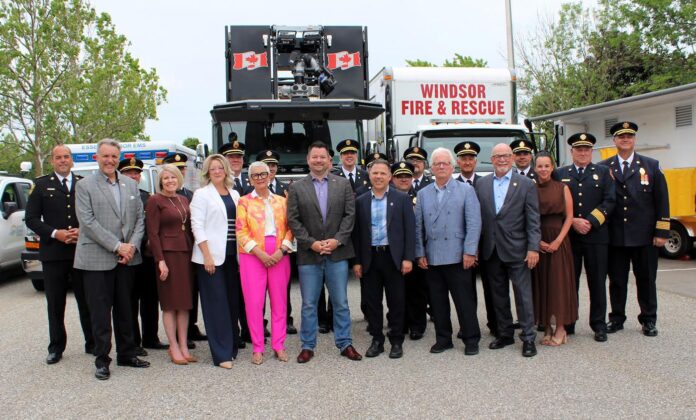
The Minister made the announcement on Tuesday, June 9, with representatives of local EMS, Fire Departments, other emergency responders, and the County of Essex at the Essex County Administrative Building.
Of the $10.8M investment, $6M will be contributed to the
Abandoned Work Program that provides financial assistance to landowners to safely plug more wells, and $3M for the Municipal Legacy Wells Transfer Payment Program, which is allowing municipalities to purchase specialized equipment, deliver training programs to first responders, and enhance emergency response to keep communities safe. The remaining $1.8M will be put towards science and research to better understand and mitigate risks posed by abandoned oil and gas wells.
Over the past three-years, Essex County has received over $1.2M through the Municipal Legacy Wells Transfer Payment Program to purchase communication, decontamination and gas detection equipment, conduct health, safety, and emergency management training for staff, develop public awareness and education materials, and update emergency response plans.
Three-years ago, the Province launched a multi-year action plan to tackle this issue head-on.
Since 2023, the Province has invested over $31M to protect people and the environment from risks associated with legacy oil and gas infrastructure.
Despite the work that has been done, there is always more to do, Minister Harris said.
“We want landowners and local leaders to know that the resources they need to keep their communities safe will always be there for them,” he said, adding the funding is about giving landowners a stronger sense of security, supporting municipalities, and doing everything the Province can to ensure communities remain safe.
Throughout Ontario, there are around 27,000 known oil and gas wells, which are primarily located on private land in Southwestern Ontario. Of those, around 3,500 are actively producing oil, gas, or salt.
Most of those wells are over 100-years-old, Minister Harris noted.
The risk associated with abandoned wells, the Province notes, is that they were capped decades ago, before more stringent practices were put into place.
Pointing to the Firefighters and Paramedics onsite, Minister Harris said they are “the real stars” of the announcement, as they are the individuals who “take these investments and actually put them into practicality; where we actually get to see the fruits of our labours actually come to fruition.”
To those who are part of emergency management, he thanked them, noting they are doing an incredible job.
At that March symposium, Minister Harris said he learned a lot about what needs to be done to be able to “manage a very difficult situation that has arisen over the last few decades here in Southwestern Ontario.
Previously, Essex County Warden/Leamington Mayor, Hilda MacDonald, noted the symposium was organized by local efforts in the wake of the tragic explosion and the year’s long state-of-emergency, that victimized Wheatley in the recent past.
“The best way to avoid oil and gas emergencies is by taking action now to plug these wells and enhance community preparedness,” Minister Harris said. “Nothing is more important than feeling safe in our homes, obviously, and our communities.”
Warden MacDonald expressed gratitude for the funding for this program that will benefit the region, in addition to others facing the same challenges.
“Your government has certainly been a friend to Essex County, helping fund the infrastructure that we need to build more homes, create more jobs, and strengthen our economy,” she said, noting that includes support for the battery plant, the developing acute care regional hospital, and the expansion of Highway 3. “Today’s announcement is another example of the Province recognizing the unique needs and circumstances of our region.”
While there is a history of oil and gas exploration connected to Essex County and neighbouring Chatham-Kent that helped build communities, “it also left behind legacy infrastructure that requires ongoing attention, planning, and preparedness,” she said.
The safety of residents, first responders, and the community is always the highest priority, MacDonald commented, which is why the County has been proud to work with the Province, the MNR, and local partners through the Legacy Oil and Gas Wells Action Plan.
She expressed the importance of regional collaboration as no community could tackle this issue on its own. “Together, we can build stronger response capabilities, share expertise, and ensure our communities are prepared for the future.”
The County of Essex was honoured when the MNR selected it to serve as the lead applicant and coordinator for the regional initiative, CAO Sandra Zwiers, said. “Our role has been to bring partners together, administer the funding, support collaboration, and help ensure the program delivers meaningful benefits across this entire region.”
Through the leadership of Essex-Windsor EMS, and participation of the seven municipal partners, a regional working group was established that met regularly throughout the project. Its members have worked collaboratively on risk assessment, emergency planning, responder training, public education initiatives, and equipment acquisition.
“The result is a coordinated, regional approach that strengthens preparedness across municipal boundaries,” Zwiers said.
She added that in May, the County took part in its annual provincially mandated Municipal Emergency Control Group Training, using a simulated emergency legacy oil and gas well incident as its scenario. That allowed staff to test plans, communications, and response procedures in a realistic setting.
Amherstburg Fire Chief and Community Emergency Management Coordinator, Michael Mio, commented the funding announced was unbelievable.
While grateful for the support, Chief Mio noted the work is not done. Continued funding will allow for the development of standard operating procedures, enhance training and preparedness, maintain specialized equipment, and strengthen the ability to protect citizens.
“Today’s announcement is about protecting Ontario, and protecting our towns and our communities,” he said.
The local regional groups working on this file, Minister Harris said, are in regular contact with each other, often taking part in cross-training. They also look at ways various emergency response groups can come together to help manage emergency situations in nearby communities that may have never had to deal with these types of situations before.
Chief Mio added the nine impacted communities work together to try to work out funding, equipment, and best practices to ensure they are approaching the matter in the same way.
Minister Harris noted it would be difficult to quantify the amount of funding that would ultimately be needed to support this file, as each case is very different. Some wells can be capped with no complications, while other situations may have one well lead to others where other remediation measures may need to be put into place.
He said the MNR is really trying to work on mapping the wells.
Essex MPP Anthony Leardi thanked Minister Harris for his continued attention to this very important matter, and the investment being made into the region in response to concerns about the legacy wells.